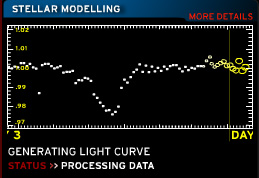
Producing Light Curves, Point by Point
The PlanetQuest Collaboratory will turn your computer (Mac, PC, Linux, and others) into a virtual astronomical observatory that you can use to make and share real scientific discoveries. You can classify stars no one has cataloged before, use the Collaboratory to do your own research, and maybe even find a new planet! We have done a significant amount of work developing and testing the Collaboratory. We have compiled a star catalog for planet searching, with about two million observations. We also have half the transit detection algorithms running on the BOINC platform. We are close to releasing a limited alpha test but for the general release beta test we will need significant additional funding to provide the infrastructure to be able to handle the large response we expect (you can help by making a tax-deductible donation), but here's a preview.
|
Producing Light Curves, Point by Point |
This is where you'll store all the discoveries you've made, including planet candidates, classified stars, asteroids, comets, new star types, and more. A treasure chest full of your real discoveries.
The world's first automated rapid light curve production facility, which you can watch as it works on your data. It takes raw pixel data from observations and corrects and normalizes, given input constraints and PlanetQuest optimization algorithms.
This shows up-to-date thumbnail information about your current target star, including coordinates, name, status, and other information. You can export target coordinates to either your telescope or third party observing software (like Celestia).
This module allows users to explore the region around the star they are currently working on. It uses RA and Dec coordinates to overlay onto a navigable starmap, giving you an opportunity to explore the neighborhood and learn about the nearby stellar bodies and formations around them.
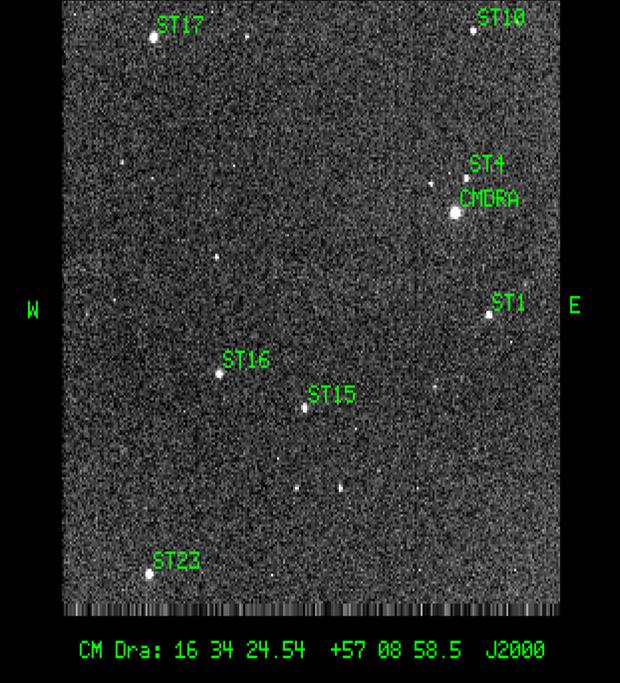 |
Explore Your Target's Stellar Neighborhood
|
This is a real-time rendering of the current star's light curve against known models displayed in 3-d OpenGL format.
Similar to the above, but focused only on modeling and mapping eclipsing binaries.
Once you've got a light curve drawn, you'll use this to see a real-time rendering of the current star's light curve against hypothesis tests in 3-d OpenGL format.
You'll be using our unique algorithms to hunt for planets. Watch as your Collaboratory automatically calibrates itself based on your star's type and tries all possible mathematical combinations to uncover the planet that might be lurking around your star.
See who's working on stars nearby you in the sky and strike up a conversation! You can meet friends while you learn about the universe together. Create science teams with your new friends.
Learn about your discoveries! What's a Delta Scuti star? What's a Cepheid Variable? How do comets form? The answers are a click away in your Collaboratory.
Collaborate with other astronomers around the world to track and report on astronomical events. The Collaboratory provides an easy way to record your observations and share your discoveries with the world!
 |
Real-time Light Curve Planetary Detector
|
Want to look for asteroids? Comets? Gravitational lense events? We've built the basic algorithms right into the Collaboratory. You change the variables and assumptions as you like.
Allows you to view your and your team's current processing statistics.
Optional experiment that allows you to run hypothesis tests using given mathematical models to understand how and why planets form. The Collaboratory returns the degree of correlation for given models. You can help scientists learn how and why planets form the way they do!