|
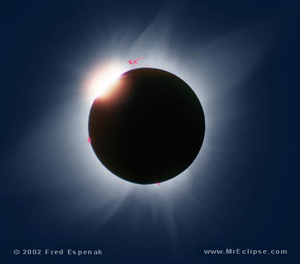
| Photo by Fred Espenak, courtesy of NASA/NSSDC. |
China has a history of astronomical observation and record keeping that goes back more than 4000 years. Numerous objects and events were observed, noted, and interpreted by Chinese astronomers centuries before they first appeared in European records. In fact, China has a longer unbroken history of astronomical study than any civilization that has ever existed.
Of particular interest to early Chinese astronomers were solar eclipses. Here is just a sampling of the many eclipse records that have survived through the centuries:
The duration of solar eclipses was recorded by Chinese astronomers as far back as 600 AD. In fact, scientists at NASA/Caltech's Jet Propulsion Laboratory have recently used these ancient eclipse timings, which are accurate to 25 minutes or so, to learn more about how our planet rotates.
Chinese astronomers were also alert to other goings-on in the sky. Appearances of comets, including what would later be known as Halley's Comet, were analyzed and recorded throughout the centuries, as was the arrival of a "guest star" in 1054 AD—a supernova whose remains can still be seen today as the well-known Crab Nebula. This supernova was also recorded by the Japanese, and possibly by the Anasazi people of early North America, but interestingly enough it was not recorded by any European astronomers—despite the fact that it was bright enough to be seen in the daytime! (For an interesting discussion of supernova sightings in ancient cultures see the Kelley and Milone reference below.)
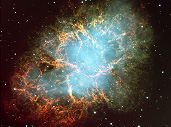 |
| The Crab Nebula. Courtesy of the European Southern Observatory. |
The Chinese also had numerous calendars throughout their history. A lunar calendar was apparently in use by 1200 BC. Another was based on the orbit of Jupiter. In this calendar, each year in Jupiter's twelve–year orbit was associated with a different animal depending on which region of the sky Jupiter was passing through that year. "The year of the rat" was followed by "the year of the ox," then "the year of the tiger," etc. This calendar is still popular today.
Chinese astronomers are also credited with the oldest known map of the stars. Created somewhere between 600 and 800 AD, it includes carefully drawn positions for more than 1500 stars. This excellent map preceded any surviving European star maps by several hundred years.
An astronomical tool that was especially important to early Chinese astronomers was the gnomon. A gnomon is simply an object—a post stuck in the ground, for instance—whose shadow is used to record the changing position of the Sun. Gnomons have been used throughout the world for centuries, but they were particularly important in China. A written record of a post specifically used for this purpose appeared as early as the 7th century BC, and by 725 AD a series of gnomons had been placed along a north–south line extending more than 2200 miles. This remarkable series of "astronomy stations" was built by I Hsing, a Chinese monk who was also one of China's great early astronomers.
Perhaps the most remarkable gnomon ever built is one that was erected by Guo Shou jing at Gao cheng zhen in 1279 AD. His somewhat unconventional gnomon is a bar mounted horizontally at the top of a broad, rectangular 12-meter- (40-foot-) high stone tower. At noon on a clear day the shadow of this bar falls onto a low stone wall that extends horizontally along the ground outward from the center of one side of the tower. This bar appears to have been carefully designed, and even has small troughs carved into it that can be filled with water to check its levelness.
As the Sun's path through the sky changes throughout the year, the location of the bar's shadow shifts along the horizontal wall. At the winter solstice, when the Sun's path across the sky is as low as it's ever going to get, the shadow reaches out to its farthest point. By marking this point, the date of the winter solstice can be pinned down. The gnomon tower at Gao cheng zhen is a genuine astronomical observatory, built to precision.
Volumes would be needed—and have been written!—to fully document the history of astronomy in this ancient and enduring civilization. Hopefully the few examples presented here give at least a hint of the unique contribution the early Chinese astronomers made to science and to history.
References:
Kelley, D., and E. Milone, Exploring Ancient Skies: An Encyclopedic Survey of Archaeoastronomy, Springer, New York, 2005.
Krupp, E.C., Echoes of the Ancient Skies: The Astronomy of Lost Civilizations, Harper & Row, New York, 1983.
Useful links and other references:
Teresi, Dick, Lost Discoveries: The Ancient Roots of Modern Science from the Babylonians to the Maya, Simon & Schuster, New York, 2002.
China
the Beautiful: Astronomy
NASA:
Eclipse 99
References
for the study of Chinese Astronomy