|
| © Nigel Ware LRPS (www.stonehengephotos.net) |
Background:
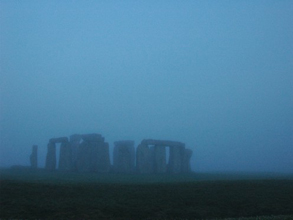
Stonehenge is one of the most revered and famous of all of the world's ancient sites. Located in southern England near the picturesque cathedral town of Salisbury, it is a stone and earth monument whose history goes back nearly 5,000 years.
Who built Stonehenge? Nobody knows. At least, no one is certain. What is known is that it was not built all at once. Rather, the various forms and pieces that we see today were constructed and assembled by more than one civilization over a span of many centuries.
The first monument at the site was constructed around 3000 BC by Neolithic builders. Using animal horns as tools, they made a circular bank of dirt 98 meters (320 feet) in diameter with a circular ditch just outside of it, and within this outer circle they dug 56 evenly spaced holes in the ground, arranged in a circle 87 meters (285 feet) in diameter. Although the bank has mostly eroded away and the holes have long since filled in, the large circular ditch surrounding them is still there today.
The next stage in Stonehenge's creation occurred many centuries later, around 2500 BC, when a partial ring of stones, each weighing some 4 tons, was assembled at the center of the circular ditch. This work appears not to have been completed however, for these same stones were apparently rearranged a couple of hundred years later and other, much larger stones were also brought in. In one of the great engineering feats of ancient times, these larger stones, weighing an average of 30 tons each, were brought some 30 kilometers (20 miles) to be assembled into a circle that actually supported a 30-meter- (100-foot-) diameter ring of smaller, 6–7 ton stones elevated more than 4 meters (13 feet) above the ground. It is the remains of this circle of massive stones and its elevated ring, known as the Sarsen Circle, that forms the most prominent and recognizable feature of Stonehenge today. The entire monument was probably completed about 3500 years ago, around 1500 BC.
 |
© Nigel Ware LRPS (www.stonehengephotos.net) |
Astronomical significance:
Why was Stonehenge built? This is the question that rings in the mind of every person who has ever seen this awesome and puzzling place. Yet here again, nobody really knows. Of course, the question may need more than one answer. Those who dug the 56 holes in the ground may have had very different reasons for what they did than those who built the stone Sarsen Circle more than 1000 years later.
One thing that can be said is that Stonehenge does not appear to have been built for strictly astronomical purposes. The placement of the holes and the stones is not precise enough for determining the dates of astronomical events with any precision.
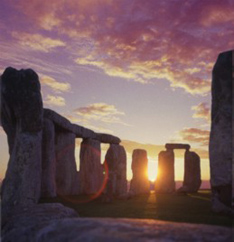
Nevertheless, Stonehenge does have some interesting astronomical alignments. The most obvious is that the overall orientation of the site is lined up with the point on the horizon where the Sun rises on the summer solstice. In fact, when seen from the center of the Sarsen Circle on the summer solstice (a nice tongue twister for you!), the Sun rises over a prominent stone known as the "Heel stone" that is positioned some 78 meters (256 feet) away. This alignment is not precise enough to be used to determine the date of the summer solstice with any accuracy, but experts seem to agree that it is too precise to have been a mere coincidence.
Other stones have been shown to line up with risings and settings of the Moon at various significant times in its orbit, but whether these alignments were deliberate or coincidental is something that has not yet been settled.
Given the extreme effort they put into their very difficult and deliberate tasks, it is clear that each group of people involved in the construction of Stonehenge had some definite reasons for doing what they did. But the reasons themselves remain to this day unclear.
References:
English Heritage website, available online at: http://www.english-heritage.org.uk/default.asp?WCI=Node&WCE=8391
Hoskin, Michael, ed., The Cambridge Illustrated History of Astronomy, Cambridge University Press, Cambridge, 1997.
Krupp, E.C., Echoes of the Ancient Skies: The Astronomy of Lost Civilizations, Harper & Row, New York, 1983.
Whitcombe, Chris, Archaeoastronomy at Stonehenge, available online at http://witcombe.sbc.edu/sacredplaces/stonehenge.html
Other useful links:
http://www.aboutstonehenge.info/index.php
http://www.britannia.com/history/h7.html