Background:
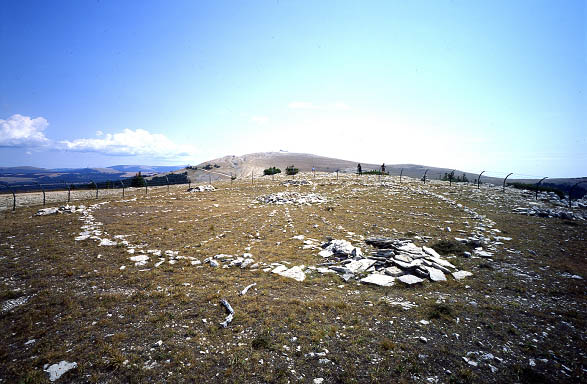
In the state of Wyoming in north central United States, spread out over an exposed grassy shoulder of Medicine Mountain, there lies a peculiar formation of rocks. These are not massive stones like those of Stonehenge. They are small and easily lifted by an adult. Nor is this monument at all as old as Stonehenge. Although the exact date of its construction is unknown, it is believed to be at most a few hundred years old. Nevertheless, though it may not compare in age or grandeur with its more famous European cousin, Big Horn Medicine Wheel is no less interesting to archaeoastronomers, and no less mysterious in its origin, history, and purpose.
|
| Looking west across Big Horn Medicine Wheel in Wyoming, in the northern region of the United States. (Photograph courtesy of Richard Collier, Wyoming Historic Preservation Office.) |
Astronomical significance:
The arrangement of this medicine wheel (here the word "medicine" refers to the supranatural, or to sacred knowledge and teachings) can best be described as resembling a giant wagon wheel. Twenty-eight "spokes," each of which is a neat line of rocks, fan outward from a central pile known as a cairn. The spokes end at the circular rim of the wheel, which is also formed of stones. Coincidentally, with a diameter of 87 feet, the rim is almost exactly the same size as the Sarsen Circle, the principal feature at Stonehenge.
There are five more cairns spaced along the wheel rim, each of which marks the end of a spoke. Also, one spoke seems to be assigned special significance, in that it extends some distance beyond the rim of the wheel, where it terminates at a seventh cairn. It was this extended spoke that first called attention to Big Horn's astronomical significance.
John Eddy, working for the High Altitude Observatory of the National Center for Atmospheric Research in Boulder, Colorado, noticed that this spoke is aligned with the direction that the Sun rises on the summer solstice. Once this was established, it was possible to sort out the alignments of the other spokes that end at cairns: one is aligned with the direction that the Sun sets on the summer solstice, while the other four point to the rising points of the bright stars Aldebaran, Rigel, Sirius, and Formalhut.
 |
| View from the south. (Photo courtesy of the US Forest Service, Bighorn National Forest.) |
The alignment with Aldebaran is particularly interesting. Aldebaran, which means "eye of the bull," is Taurus the bull's shining right eye. As with all stars, Aldebaran always rises from the same point on the horizon. However, the time at which it rises depends on where Earth is in its orbit. During some months Aldebaran will be rising during the night, in which case its rising can be observed. In other months Aldebaran will rise during the day, in which case it will already be high in the sky by the time darkness sets in.
On the days leading up to the summer solstice, Aldebaran actually rises just as the Sun is rising, and sets again when the Sun sets, so that it cannot be seen at all, day or night. However, when the Medicine Wheel was built, Aldebaran rose just before the Sun as the summer solstice approached. (The shift in its rising time on the summer solstice is due to the precession of Earth's rotation axis.) In other words, the appearance of Aldebaran to the east just before sunrise may have signaled to the builders of the Medicine Wheel that the summer solstice was approaching.
Big Horn Medicine Wheel is not unique. There are some fifty "wheels" known to be scattered about the Great Plains of Canada and the United States. Their ages vary considerably, from those such as Big Horn that are relatively recent, to genuinely ancient sites like the Majorville Cairn in Alberta, Canada, estimated to be some 4500 years old. Although differences exist, these wheels are remarkably similar to each other. And yet, the astronomical alignments seen at Big Horn are not apparent at many of the other wheels. Because of this, some experts question the significance of these alignments.
Who built these stone wheels, and why did they build them? Were such astronomical alignments as seen at Big Horn and some of the other wheels intentional? If so, how were they used? Despite the number of these monuments that have now been studied, these questions still remain largely unanswered.
References:
Kelley, D., and E. Milone, Exploring Ancient Skies: An Encyclopedic Survey of Archaeoastronomy, Springer, New York, 2005.
Krupp, E. C., Echoes of the Ancient Skies: The Astronomy of Lost Civilizations,
Harper & Row, New York, 1983.
Other useful references and links:
Maps
and photographs
Medicine Wheel National Historic Landmark
Stanford
Solar Center
US
Forest Service, Bighorn National Forest