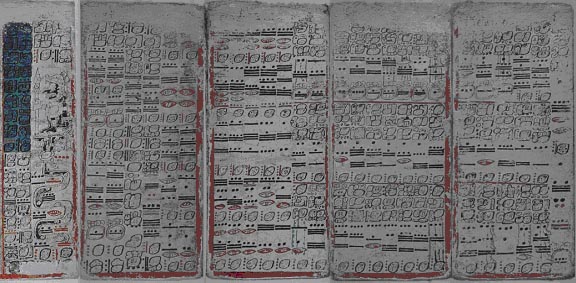
Photograph © Andreas Fuls, Technische Universität
Berlin
http://www.archaeoastronomie.de
Background:
Today the eager scholar, whether child or academician, has at his or her fingertips virtually all that humanity has learned of a subject. If he or she has access to the internet, the information is literally at hand by way of the computer keyboard! If not, the information can be found in books at any library or bookstore. But human beings were exploring the Universe long before they could record their discoveries in mass-produced collections of printed pages. Written records of early scientific knowledge are rare and, to the historian at least, valuable almost beyond compare.
The Dresden Codex is basically an astronomy textbook that was written between 1200 and 1250 AD in the part of the world known today as the Yucatán, in Mexico. It is one of three codices (ancient manuscripts) that escaped destruction by the Spanish conquistadors in the 16th century when they took over that region. It turned up in Dresden, in what is now Germany, in the 1700s and has been there ever since—hence the name.
The Dresden Codex is not the oldest astronomy textbook in existence. Not by any means. Claudius Ptolemy's Almagest, containing an analysis of planetary orbits, was written more than 1000 years before, and the Babylonians in the 19th century BC recorded astronomical information onto stone tablets. For that matter, a bone with notches cut into it recording the lunar phases—not exactly a "textbook," but believed by some to be the first written record of astronomy—was carved 20–30,000 years ago, when the Earth was still in the last Ice Age (see the article on the Blanchard Bone).
No, what makes the Dresden Codex so important is not so much its age, as the fact that it is one of the only remaining written records of the remarkable astronomical knowledge of the great Mayan civilization.
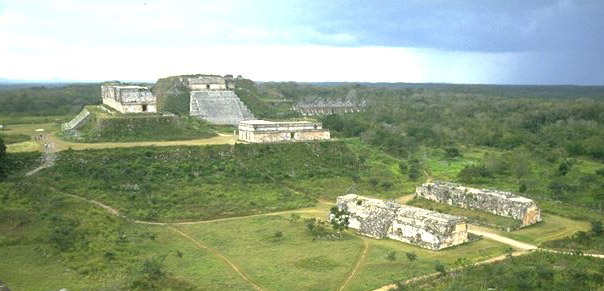
The ruins at Uxmal, including the Palace of the Governor (far left, in
the distance),
which faces the southernmost rising point of Venus. Photograph © Clive Ruggles, University of Leicester
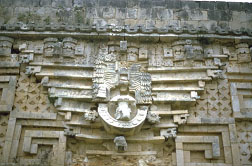 |
| Carvings on the Palace of the Governor at Uxmal, which include more
than 350 emblems of Venus. Photograph © Clive Ruggles, University of Leicester |
A careful look at Mayan cities shows that astronomy played a large part in their culture. Numerous structures, such as the buildings and pyramids at Uxmal or the famous Caracol of Chichén Itzá, have features that were designed to line up with specific astronomical objects and events.
Apparently much of Mayan astronomical knowledge was used for purposes that today would be called astrology—avoiding what they believed to be the dangers associated with eclipses, or the disappearings and reappearings of Venus, for instance. But this need not diminish our appreciation of the scope of their accomplishment in learning so much about what goes on in the cosmos.
Astronomical significance:
The Dresden Codex contains numerous astronomical tables and information in its 74 accordion–style pages. For instance, one way in which the Mayans measured time involved a sacred almanac of 260 days. One table in the codex, a table that takes up eight pages in itself, covers a time span of 46 such almanacs, counted out in groups of 177 and 178 days.
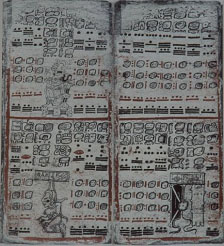 |
Excerpt from the Dresden Codex solar eclipse table. Photograph © Andreas Fuls, Technische Universität Berlin |
What is the explanation? Consider first of all that solar eclipses were important to many ancient civilizations since they were believed to signal dramatic, even terrifying events in the heavens. Consider also that solar eclipses, which require perfect alignment of the Sun, the Moon, and the Earth, can occur only once every six lunar cycles (a lunar cycle is a complete cycle of lunar phases—from full Moon to full Moon, for example). These are the so–called "eclipse seasons." Finally, consider that six lunar cycles take 177 days, and it becomes clear that this table in the codex is a chart for predicting solar eclipses.
Another table covers 65 of Venus's synodic revolutions (orbital cycles as seen from Earth)—a time span of no less than 104 years. Unlike some early cultures, the Mayans were aware that the "Morning Star" and the "Evening Star" are one and the same; but they feared Venus’s regular reappearance in the morning sky after its lengthy disappearance, and so kept elaborate records to be able to predict its comings and goings.
These brief descriptions give only the merest glimpse of the complexities that are found in the codex. Written in hieroglyphics on tree bark, using a logical and easy-to-follow numerical system, it makes fascinating reading! And it is an impressive accomplishment for a 13th century civilization.
References:
"The Dresden Codex," from the Technische Universität Dresden, available online
at http://www.tu-dresden.de/slub/proj/maya/mayaeng.html
Hoskin, Michael, ed., The Cambridge Illustrated History of Astronomy, Cambridge University Press, Cambridge, 1997.
Useful links:
Die Maya-Handschrift Codex Dresdensis (extensive information, mostly in German)
Foundation
for the Advancement of Mesoamerican Studies, Inc. (FAMSI)
Pomona
College History of Astronomy