|
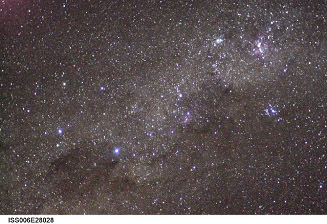
| Stars of the southern sky as seen from the International Space Station. The beautiful Southern Cross can be seen in the lower left, with the dark Coal Sack Nebula beneath it. The bright patch to the upper right is the Carina Nebula. (Photograph by astronaut Donald Pettit, courtesy of NASA.) |
Background:
Who first realized that the sky continues beyond the birds and the clouds? Who first noticed, really saw, that faint, pinpoints illumine the dark each night, that a brilliant, distant light crosses the sky each day, and that a light of ever-changing shape, sometimes round, sometimes crescent, moves freely from night to day to night?
This being, whoever he or she or it was, was the first astronomer. We don't know who first made this evolutionary step since no record of the moment was left—at least none that we can read today. And that brings us to a less ambitious though equally important question: Who was the first person to write about the Sun and Moon and stars? What is the earliest written record of astronomy that has survived to this day?
It shouldn't be surprising that this question has no easy answer. The dinosaurs apparently left no written records of their thoughts or knowledge, nor did the earliest mammals. Even our human ancestors didn't write down their observations until comparatively recently. The Chinese were writing clearly about astronomy by at least 2650 BC. We know this because some of their writings have been preserved through the centuries and can still be read today. But what about earlier, perhaps simpler, cruder records?
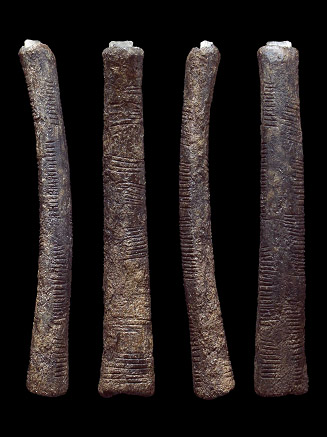 |
| The Ishango Bone. (Photograph courtesy of the Museum of Natural Sciences, Brussels, Belgium.) |
In 1962 Jean de Heinzelin discovered a bone near the shore of Lake Edward, on the border between what are now Uganda and the Democratic Republic of the Congo (formerly Zaire). This bone, known as the Ishango Bone, was originally thought to be between 6000 and 9000 years old. However, more recent efforts place the age at something like 20,000 years, during the Upper Paleolithic period.
The Ishango Bone is remarkable in having a number of notches carved in three rows, markings that appear to be deliberate. They are arranged in 16 groups, each group having a different number of notches, from 3 to 19. Because of the complexity of the groupings it is generally agreed that the markings are not random. But what then was their purpose?
Various details have led some researches to suggest that the Ishango Bone is some kind of primitive mathematical table. For example, along one edge the number of notches in each group is a prime number (prime numbers are divisible only by themselves and one; e.g., 1, 3, 5, 7, 11, 13, 19, etc.) Coincidence? Perhaps. But then, there are three separate rows of notches, and the total number of notches in each row is a multiple of twelve. Another coincidence? Maybe. But along one row, the notches in adjacent groups appear to be related by a factor of two: 3 notches in one group and 6 in the next, then 4 followed by 8, then 10 and 5. A crude multiplication table? Or another coincidence?
Astronomical significance:
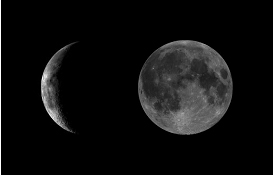
If these arrangements are not coincidences and the mathematical interpretation is correct, then the Ishango Bone clearly has little to do with astronomy. However, an alternative explanation was put forward by Alexander Marshack in 1965. Noticing certain patterns among the notches, Marshack claimed that the markings are a sort of lunar calendar, a record of the changing phases of the Moon. Marshack’s idea has yet to be proved or disproved. If it is correct, the Ishango Bone is certainly a contender for the oldest written astronomical record. But would it definitely be the oldest? Not necessarily.
 |
Photograph courtesy of NASA. |
You see, the Ishango Bone is not the only artifact of that age believed to have had astronomical significance. A number of similar bones have been found, the oldest of which date back as far as 30,000 years ago, when Earth was still engulfed in the last Ice Age. One of the oldest of these is the Blanchard Bone, a carved segment of reindeer bone that was found in the Blanchard rock shelter in modern day France. It too is marked, but with a complexity that is startling. Whereas the notches in the Ishango Bone are simple straight tick marks of varying lengths all in neat rows, the 69 notches that decorate the Blanchard Bone include more than 24 distinctly different shapes that make a winding, snakelike design. Here especially it seems clear that the marks were intentional rather than accidental; and again, some researchers believe that the marks may indicate a detailed record of lunar phases.
The exact meaning of the coded markings on these and similar ancient bones may never be known with any certainty. But at the very least it seems likely that our ancestors tens of thousands of years ago were keeping track of something with these primitive counting tools. Is it such a stretch to imagine that they might have been tracking what they saw in the sky above?
References:
Kelley, D., and E. Milone, Exploring Ancient Skies: An Encyclopedic Survey of Archaeoastronomy, Springer, New York, 2005.
Krupp, E. C., Echoes of the Ancient Skies: The Astronomy of Lost Civilizations, Harper & Row, New York, 1983.
Royal Belgian Institute of Natural Sciences
University at Buffalo: State University of New York
Other useful references and links:
Marshack, A., The Roots of Civilization: The Cognitive Beginnings of Man’s First Art, Symbol and Notation, McGraw-Hill, New York, 1972.