
The Sun (Photo courtesy NASA/JPL-Caltech.)
|
The Sun (Photo courtesy NASA/JPL-Caltech.) |
Different cultures throughout history have chosen many different days to mark
the passage of the year, based on as many different reasons, but astronomically speaking, the year falls neatly into two parts
that are framed by two specific days—the
summer and winter solstices.
For millennia the solstices have been of great practical importance, particularly for agricultural societies, since they provide bench marks for when crops need to be planted and other important matters. But for many they have held religious significance as well. In any case, various ancient cultures developed ways for marking and honoring the solstices (see for example the articles on Stonehenge, Early Chinese Astronomy, Big Horn Medicine Wheel, and Nabta Playa). One of the most striking ever discovered is the famous Chaco Canyon "Sun Dagger."
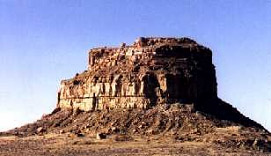 |
| Fajada Butte, near the top of which the "Sun dagger" would appear. (Photo courtesy of Chaco Culture National Historic Park.) |
In what is now the state of New Mexico in the southwestern United States, in an area known as Chaco Canyon, are the remains of an elaborate development of the Anasazi people who lived in the region from about 500 to 1300 AD. Some 120 meters (400 feet) above the canyon floor near the top of an outcropping known as Fajada Butte, three slabs of sandstone are leaning against a rock wall creating a shaded space. Carved into this shaded wall are two spiral petroglyphs, one large and one small. Sunlight passes over them at various times throughout the year as it streams through chinks between the sandstone, but it was not until the 1970s that their true purpose was literally illumined.
In 1977 Anna Sofaer, an artist, was exploring rock art in the region and came across the light patterns on the two spirals. Suspecting that the rock arrangement and spiral carvings might have been intentional, she returned to the site at various dates throughout the year and, along with her colleagues, was eventually able to establish the following facts.
 |
 |
 |
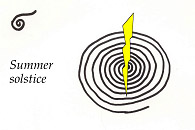
On the summer solstice, a single sliver of sunlight—which she dubbed a "Sun dagger"—appeared near the top of the larger spiral and over a period of 18 minutes "sliced" its way down through the very center, cutting the spiral in half before leaving it in shadow once again. On the winter solstice, two daggers of light appeared for 49 minutes, during which they exactly framed the large spiral.
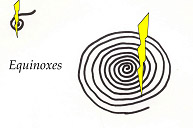
Finally, an equally fascinating and more complex light show occurred on the spring (vernal) and fall (autumnal) equinoxes. The large spiral is carved in such a way that, counting from the center outward to the right, there are nine grooves. On each equinox a dagger of light appeared that cut through the large spiral—not through its center but exactly between the fourth and fifth grooves from the center. In other words, it cut exactly halfway between the center and the outer edge of the spiral, just as the equinoxes cut the time between the solstices exactly in half. Meanwhile, a second dagger sliced through the center of the small spiral.
These "light shows," which presumably had been going on for centuries, continued for several years after their rediscovery. However, in 1989 it was found that the granite slabs had shifted. The alignments that had apparently been arranged so carefully by the Anasazi were no more.
Similar light displays marking the solstices and/or equinoxes can be found at other locations in the southwestern United States and Mexico. In another Anasazi ruin in Hovenweep National Monument near the borders of Utah and Colorado, light beams also illuminate spiral petroglyphs on the summer solstice. At Burro Flats in Southern California, a winter solstice Sun points a finger of light to the center of five concentric rings in an early Chumash rock art display. In a Tipai shrine known as La Rumorosa in Baja California on the western coast of Mexico, a dramatic display can be witnessed on the winter solstice when a "dagger" of light appears to shine from the eyes of a figure painted on a shaded rock wall.
Although the true purpose of these and other astronomically oriented light displays may never be known for certain, it seems clear that the indigenous people of the region had an awareness of and appreciation for the Sun and its changing path through the sky.
References:
Kelley, D., and E. Milone, Exploring Ancient Skies: An Encyclopedic
Survey of Archaeoastronomy, Springer, New York, 2005.
Krupp, E. C., Echoes of the Ancient Skies: The Astronomy of Lost Civilizations, Harper & Row, New York, 1983.
Other useful references and links:
Chaco Canyon Tour: Fajada Butte
Exploratorium
Fajada
Butte: Home of the Sun Dagger
The Solstice Project